Sit. Speak. Receive.
Ten minutes on a cushion, one true sentence, and a talk composed for what you actually said — not selected for you, written for you, and spoken.
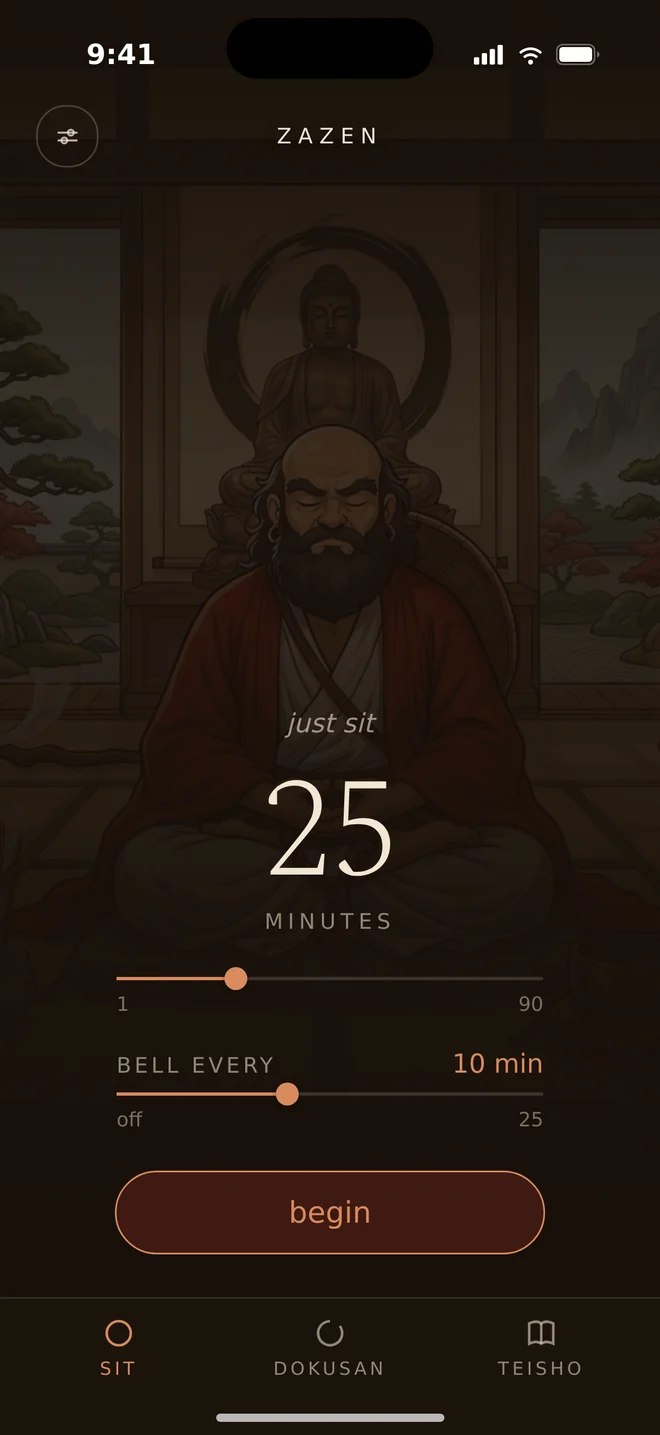
Real bells, and nothing else.
Set the length and the interval. The session bell is a bronze bonshō cast in 1532; the interval bell is a kin from Daitoku-ji in Kyoto. They were recorded properly and released into the public domain — no synthesised chimes, no music underneath, no voice talking you through it.
Ten minutes is a real beginning. Twenty-five is a period. Nothing counts a streak and nothing congratulates you.
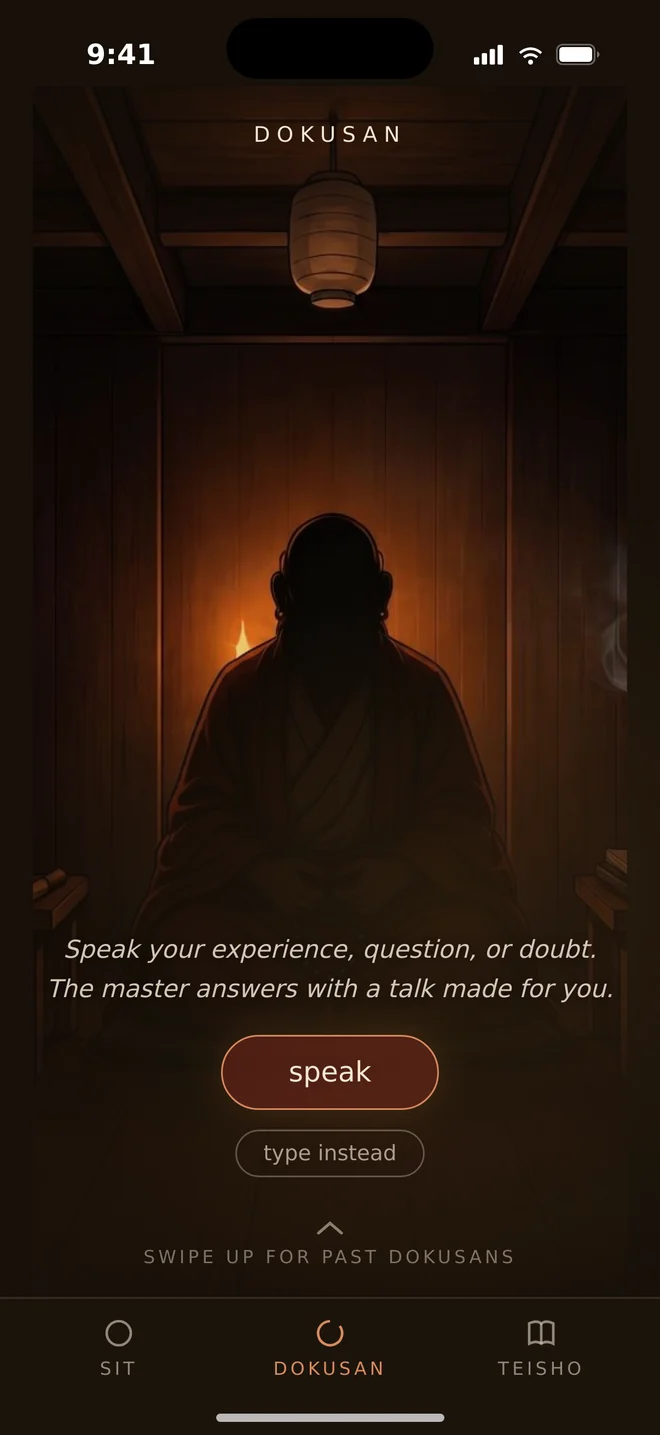
Say the thing you would say in dokusan.
Not a summary of your day. The one true sentence — what surfaced near the end of the sitting, the difficulty you keep circling, the question you cannot put down. Speak it aloud, or type it if the morning is not a speaking one.
There is no character limit and no prompt to fill in. Ramble if you need to; the teacher is listening for where the practice actually is, not for a well-formed question.
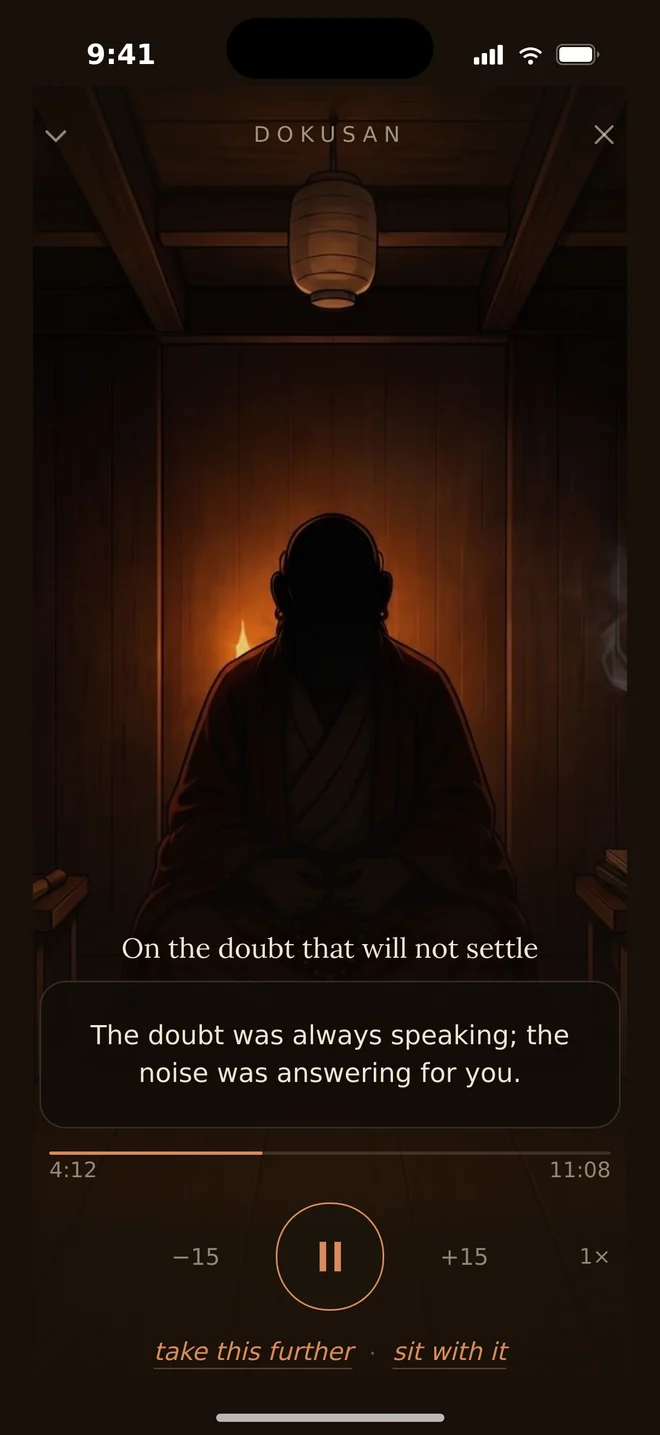
A talk made for that, in a voice.
Around ten minutes, composed for what you just said, spoken aloud with the text following line by line so you can read along or close your eyes. Six teacher voices to choose from — one for dokusan, one for teisho, if you want them different.
It will not always agree with you, and it is not built to make you feel attended to. Some mornings it takes the thing you said and turns it over until it looks different.
And next month, it remembers this morning.
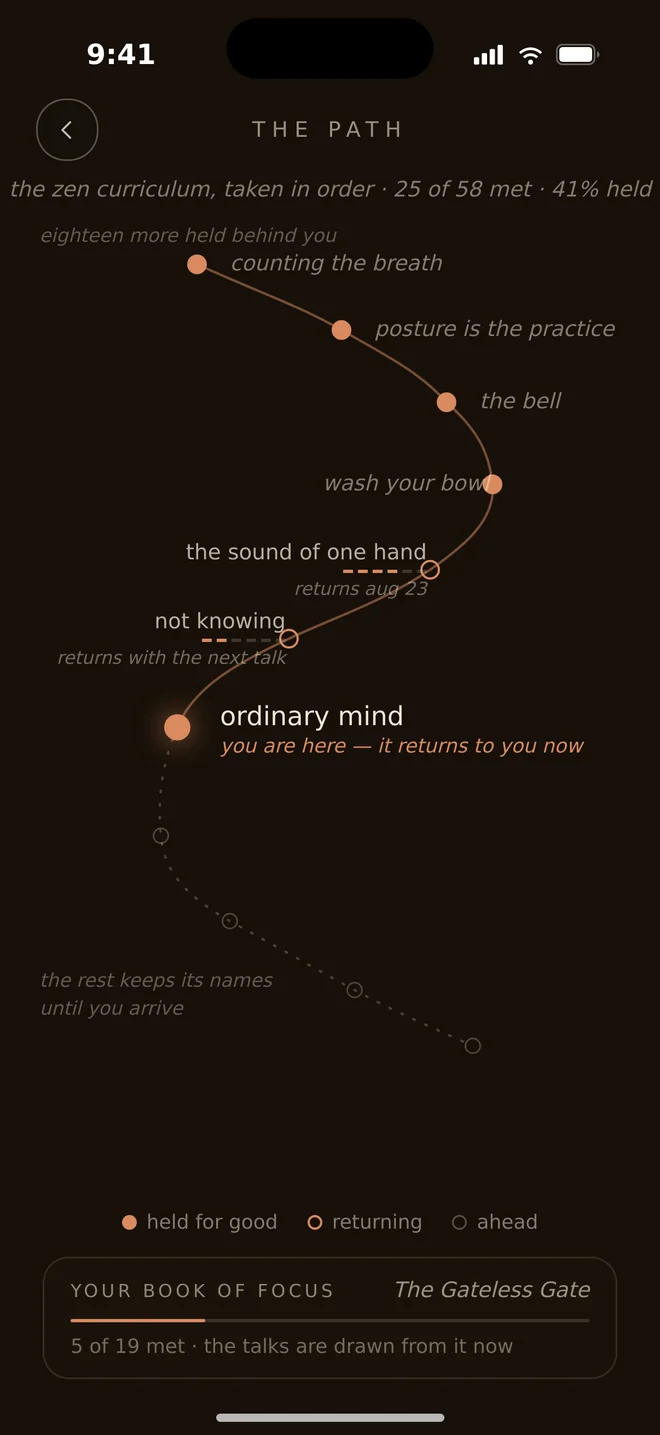
Fifty-eight concepts, taken in order.
A curriculum drawn from the Gateless Gate, the Blue Cliff Record, the Platform Sutra, the Heart Sutra and the old masters — all works long in the public domain, retold in the teacher’s own words rather than read out.
Each talk is followed by three questions you answer aloud. He listens for what you actually understood rather than for the right phrase, and builds the next talk from there. Get something wrong and it is taught again, differently.
Bring your own books too — your school’s commentaries, your teacher’s material, your own notes. Set one as the book of focus and it is taught before the classics.
What the teacher is, and what it is not.
It is an artificial intelligence. Every talk is written fresh and spoken in a synthesised voice. No living teacher is imitated, no recording is replayed, and no human reviews what you said.
It holds no transmission. It will not confirm your understanding, pass you on a koan, ordain you, or speak in your teacher’s name. Those belong to a person. A companion between meetings — not a lineage, and it will not pretend to be one.
Your practice is stored under a key we never keep. The archive at rest cannot be opened by us, by anyone who steals a backup, or by anyone who compels us. To answer you, the teacher has to read you — so your key travels with the request, is held in memory only as long as it takes, and is discarded. That is not end-to-end encryption and we will not call it that. The exact truth of it →
Before you begin.
- Do I need to know anything about Zen to start?
- No. The app asks six questions at the beginning and takes a different path depending on how you answer — a beginner is not dropped into koan study. If you have never sat before, start with ten minutes and let the teacher explain the rest as it goes.
- What is a dokusan?
- In a monastery, dokusan is the private meeting between student and teacher — a few minutes, alone, where you say where your practice actually is and are answered. It is the heart of Zen training and the part that is hardest to get outside a retreat, because it requires a person and their time. That is the gap this app was built for.
- And a teisho?
- A teacher's formal talk on a classical text — a koan, a sutra, a line from an old master. Not a lecture about Zen: a demonstration of what the text points at. The app has fifty-eight of them, taken in order, and asks you three spoken questions after each.
- Is this therapy?
- No, and it is not a substitute for it. Nobody is monitoring what you say. Zen is a practice rather than a treatment, the app makes no claim to improve any condition, and if you are in crisis it is the wrong tool — contact your local emergency services or a crisis line.
- How is this different from asking ChatGPT?
- A general assistant answers your question. This one sits you down first, listens to a practice rather than a problem, answers out of one tradition instead of all of them at once, speaks rather than types, and remembers where your practice was last month. It is also, deliberately, not always agreeable.
- How is this different from Calm or Headspace?
- Those are relaxation apps and they are good ones. There are no sleep stories here, no breathing exercises for stress and nothing to help you fall asleep. This is training in a tradition, and some mornings it is harder work than you wanted.
- Can you read what I say?
- The stored archive, no — it sits encrypted under a key we never keep, so a stolen backup is noise and a subpoena gets us nothing. But to write you a talk the teacher must read what you wrote, so during those moments the server sees your words in the clear. It is not end-to-end encryption and we will not call it that.
- Do my words train anyone's model?
- No. They never enter a training set, and no person reviews them.
- I already have a teacher. Is this disloyal?
- Tell the app so and it changes its stance: it studies alongside that relationship rather than in place of it, never speaks in your teacher's name, and hands koans, precepts, ordination and questions of readiness back to them. Upload your school's material and that material is taught first, above anything the app would otherwise say.
Begin with one, free.
- No ads
- No streaks
- No gamification
- Cancel in two taps